Join us in Toulouse.
EICS 2027 takes place in Toulouse, France — the self-styled Ville Rose , where pink terracotta rooftops meet Europe's aerospace frontier, and centuries of Mediterranean culture line the banks of the Garonne.
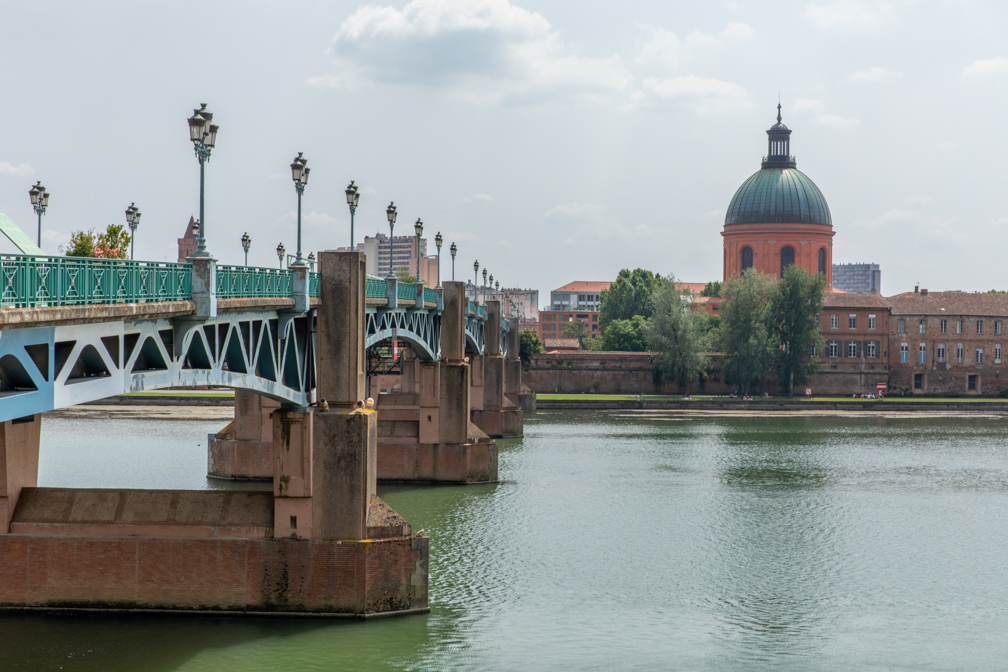
Toulouse, France
Toulouse earns its nickname from the warm terracotta brick of its old town — the same earthy tones that define the city's rooftops, courtyards, and covered passages. It is France's fourth-largest city, home to over 130,000 students, and the capital of Europe's aerospace industry.
Conference venue
EICS 2027 will be hosted at the Amphitheatre Herbrand , inside the IRIT (Institut de Recherche en Informatique de Toulouse) building on the campus of Université Paul Sabatier . IRIT is one of France's largest computer science research laboratories, making it a fitting home for a conference devoted to engineering interactive computing systems.
Getting to Toulouse
Toulouse is well connected by air, rail, and road. The city centre and university campus are both easily reached from the main arrival points via public transport.
Toulouse-Blagnac Airport (TLS) offers direct flights from across France and Europe. The airport is connected to the city centre by bus + tramway (Bus 31 Tram T1) in around 50 minutes (rush hours), with onward connections to the university campus.
toulouse.aeroport.frGare Matabiau is Toulouse's central train station. High-speed TGV services connect Paris in around 4h20, and regional TER services link many southern French cities. From Matabiau, Metro line A + B reaches the campus zone in under 20 minutes.
sncf-connect.comToulouse-Métropole operates two metro lines, a tram, and an extensive bus network. Metro line B stops directly at Université Paul Sabatier, a few minutes' walk from IRIT. Tickets are available at all stations.
Toulouse public transport network (in french)Toulouse is served by the A61 (from the east) and A62 (from Bordeaux) motorways. Parking is available near the campus, but public transport is recommended for the final stretch. The campus entrance is on the D113 (Route de Narbonne) main road.
Campus access mapToulouse
Situated at the foothills of the Pyrenees where the Garonne widens into broad green banks, Toulouse is one of France's most distinctive cities. Its old town — a labyrinth of arcaded squares, Renaissance hôtels particuliers, and the vast Capitole — glows pink at sunset, the brickwork deepening from amber to terracotta as the light fades.
Beyond the architecture, Toulouse is a city in motion. It hosts the headquarters of Airbus and the Cité de l'Espace science museum, making it the undisputed capital of European aerospace. Its four universities and grandes écoles draw over 130,000 students, filling the cafés around Saint-Sernin basilica with the kind of intellectual energy that has characterised the city since the twelfth century.
The capital of Occitania — where the language, cuisine, and landscapes of the south all converge.
du Midi
Financial Support to attend EICS'27
Gary Marsden Travel awards
The Gary Marsden Travel Awards aim to support undergraduate and graduate students and early-career researchers (i.e., those who received their Ph.D. ≤5 years ago) in attending HCI conferences and events. SIGCHI will prioritize presenters and first-timers.
There are seven deadlines: the 9th of January, February, March, May, July, September, and November at 11:59 PM AoE .
This fund is named in honour of Gary Marsden ’s contributions and inspiration in HCI4D and for the global HCI community.
Apply to the SIGCHI Gary Marsden Travel AwardWho was Gary Marsden?
“Gary Marsden a Professor of Computer Science at the University of Cape Town (UCT) in South Africa, was a passionate advocate for people – all people. He pioneered the field of Information and Computer Technology for Development (ICT4D) and, in his own wonderfully unpretentious way, he changed the world in positive ways for his students, his colleagues, his community, the profession and, indeed, the world. A self-described geek, he created technology WITH people rather than just for them, so that the result would actually meet their needs so that it would empower them. After getting his doctorate and working for several years in London, he moved to South Africa to teach at UCT in 1999. There, his research focused on mobile device interfaces because mobiles are ubiquitous in most of the “developing” world, and he became world-renowned for his work. He died very suddenly of a heart attack in December, 2013 at the age of 43, just days before his birthday. It is in his honour and memory that this program is named for him.”
For more information on Gary’s life, see this 2014 article https://interactions.acm.org/archive/view/march-april-2014/in-memory-of-gary-marsden
For more information of this program of student support from SIGCHI please see:https://sigchi.org/resources/gary-marsden-travel-awards/